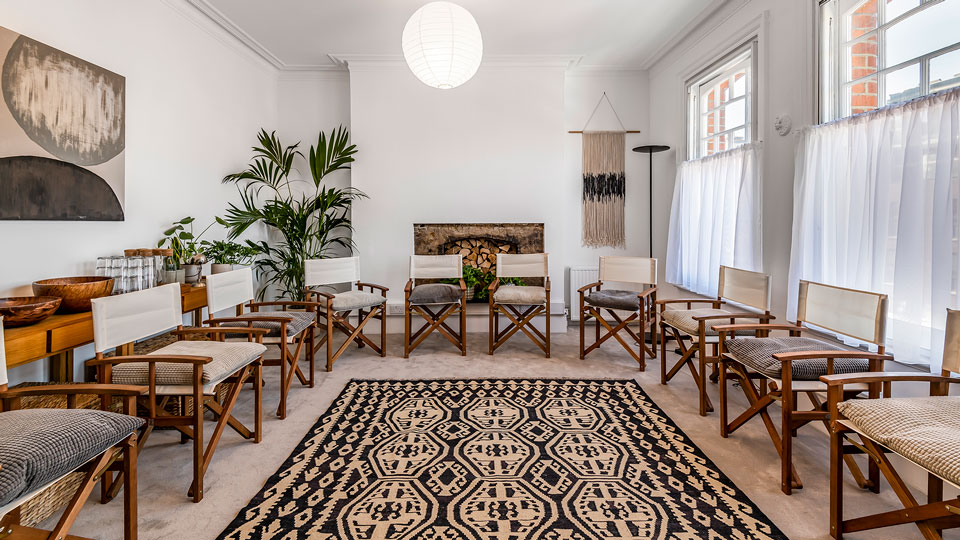
A new weekly therapy group for doctors, starting September 2026, with 1:1 preparatory sessions to support the process of joining.
This is a hybrid group, with three online sessions and one in-person session each month, held on Wednesdays 5:00–6:30PM at Camden Therapy, London NW1 0NE.
Up to eight places available.

Facilitated by Emma Reicher, UKCP-registered Psychotherapist and Group Analyst specialising in somatic approaches to mental health. Emma’s work brings together Group-Analytic Psychotherapy, BodyMind Maturation™, Dreamwork, and Elemental Chi Kung to support emotional plasticity, nervous system capacity, and a grounded relationship to self and others.
She has extensive experience in both 1:1 and group work, holding complex emotional material and creating spaces where people can speak openly, decompress, and reconnect to their humanity.
Why this group?
I am a Psychotherapist and Group Analyst with a particular interest in the demands doctors face in their lives and careers.
My husband is a hospital consultant in a high-acuity specialty who returned to work after a life-threatening illness, and many of my close family members and friends are doctors practising across a range of disciplines. During Covid, I helped to develop and deliver a support group service for NHS Practitioner Health, offering much-needed sanctuary to clinicians on the frontline.
A Therapy Group is a safe, confidential space to talk about what you are going through — both at work and at home — and to hear the experiences of others. Together, the group forms a stabilising field where coping efforts are acknowledged, patterns become clearer, and difficult feelings can be expressed, metabolised, and held.
When you relate to others in a group, beliefs and behaviours shaped in early family and social environments naturally surface. Reflecting on these patterns in a therapeutic context can soften entrenched defences, interrupt transgenerational cycles, and open space for more flexible and authentic ways of being.
Group therapy is not a quick fix. It works at depth — reaching entrenched patterns and supporting a more meaningful relationship with yourself and others over time.
Details
• The group begins September 2026, with monthly preparatory sessions in advance (£120/session)
• Group membership: £300/month
• Weekly 90-minute sessions
• Breaks at Christmas, Easter, and August
• Minimum commitment of one year
• No contact between members outside sessions, supporting confidentiality and safety
• Conversation is free-floating and undirected — the space is co-created, and no two sessions are the same
About Group Therapy
Group Psychotherapy emerged in crisis during the Second World War, pioneered by S.H. Foulkes at Northfield Military Hospital. His groups were designed to help traumatised soldiers make sense of what they had been through. Rather than facing their pain alone, they sat together to speak into it.
Foulkes later founded the Group Analytic Society (1952) and the Institute of Group Analysis (1971). Today, Group Analytic Psychotherapy is a well-recognised, NHS-approved treatment modality — awake to systemic pressure and inequality, and uniquely placed to locate personal distress within a shared social context.